Community News•Oct 4, 2026
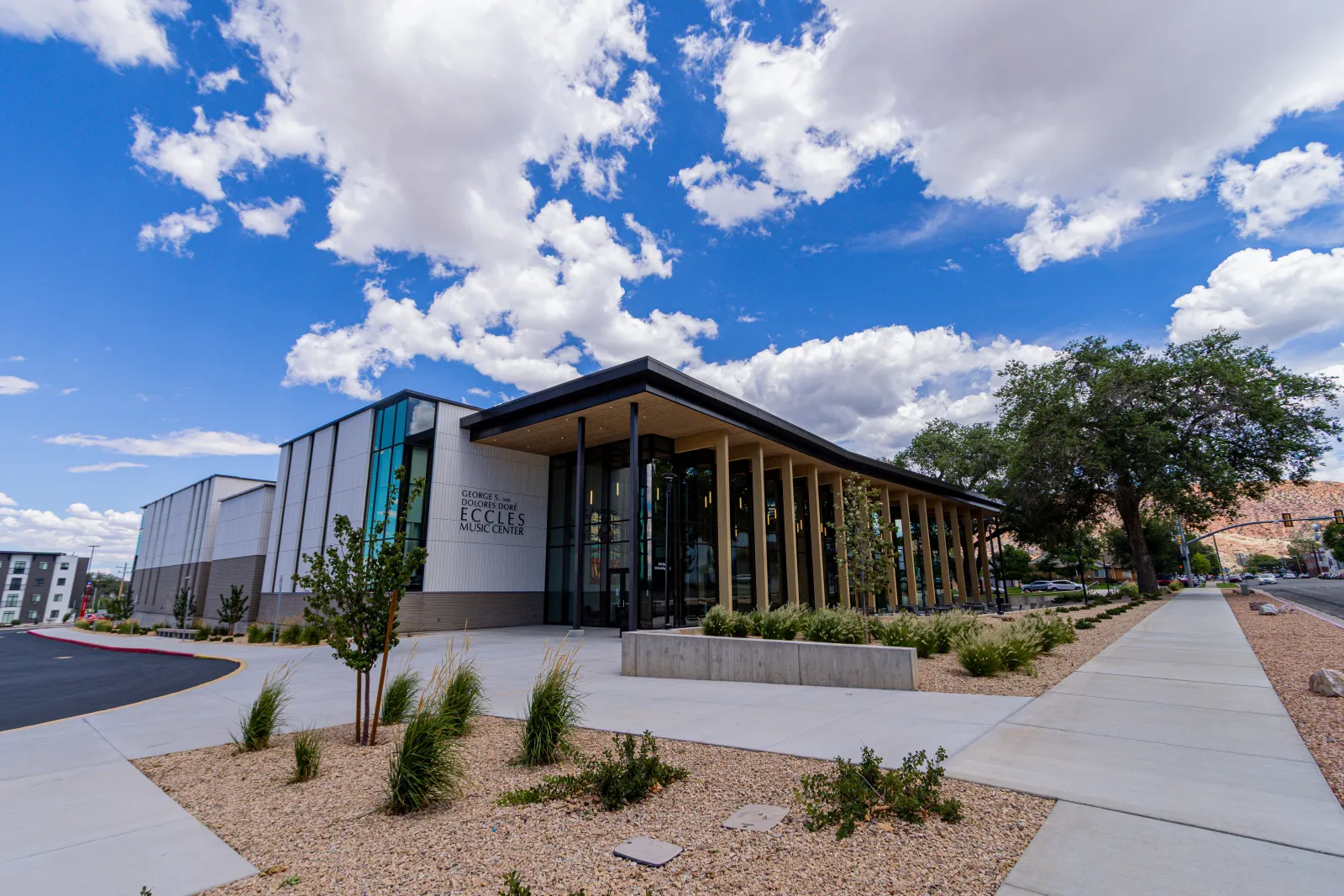
SUU Opens $34M Eccles Music Center and 510-Seat Okerlund Concert Hall in Cedar City
0 views
2 min read
Every region has a founding story. Southern Utah's usually starts in 1861 — but the Leavitt family's thread runs back to Puritan Massachusetts, a Harvard founding committee, and forward to the Utah governor's office.
Key takeaway: Every region has a founding story. Southern Utah's usually starts in 1861 — but the Leavitt family's thread runs back to Puritan Massachusetts, a Harvard founding committee, and forward to the Utah governor's office.
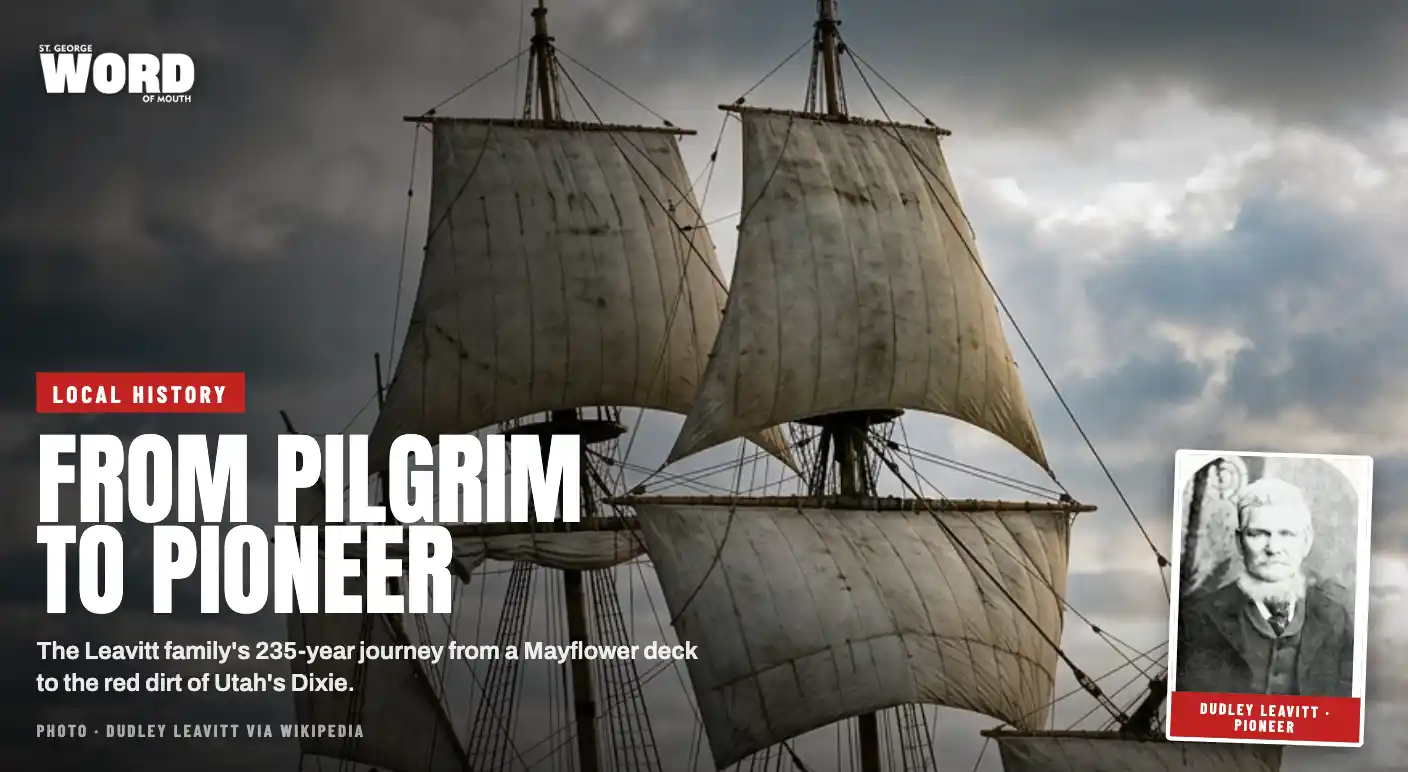
Dudley Leavitt portrait via Wikipedia
Every region has a founding story it tells the most often. In southern Utah, that story usually starts in October 1861, when Brigham Young stood at General Conference in Salt Lake City and read the names of 309 families called to grow cotton in the desert below the Great Basin. It's a good story, and a true one.
But one family connected to that founding effort carries a thread stretching back almost two and a half centuries earlier, to the rocky shoreline of colonial Massachusetts. That family is the Leavitts, and their story runs from a Puritan meetinghouse in the 1600s, through a Harvard founding committee, to the governor's office in Salt Lake City in the 1990s.
Dudley Leavitt was born in 1830 in Hatley, in what was then Lower Canada. His family converted to the Church of Jesus Christ of Latter-day Saints in 1836, when Dudley was just six years old, setting off a path that took the family from Canada through Kirtland, Ohio, and Nauvoo, Illinois, before they joined the broader westward migration. Dudley crossed the plains as part of the Milo Andrus Company, arriving in the Salt Lake Valley in August 1850.
He didn't stay in northern Utah long. Leavitt became one of the founding figures of several Washington County settlements, including Santa Clara, Gunlock, and Hebron, putting him among the small circle of pioneers who turned the harsh Virgin River basin into livable ground years before St. George itself was fully established.
His most lasting contribution may not have been agricultural. Later in life, Leavitt became a central figure in relations between Mormon settlers and the Native tribes of southern Utah, working as an intermediary credited with preventing at least one attack on non-Mormon settlers in the region. His own family history is also tied, sometimes uncomfortably, to one of Utah's darkest chapters: Leavitt has been named in connection with the 1857 Mountain Meadows Massacre, though he reportedly never discussed the event publicly in his lifetime, saying only that his hands had "never been stained by human blood." It was his own granddaughter, the historian Juanita Brooks, who later wrote the definitive historical account of the massacre, a project she pursued with notable ambivalence about her grandfather's possible role in it.
Dudley Leavitt's first name wasn't an accident. He was named for his ancestor Thomas Dudley, who served as the second colonial governor of the Massachusetts Bay Colony in the 1600s and helped found Cambridge, Massachusetts. Thomas Dudley's reach extended into one of the most enduring institutions in American history: in 1636, he was named to the colony's committee charged with establishing a college at Newtowne, the body that would become Harvard College. He went on to serve on Harvard's first Board of Overseers, a position he held until his death, and signed the college's official charter in 1650 during his final term as governor. He's commonly counted among Harvard's founders; a verse by his daughter, the poet Anne Bradstreet, once adorned one of Harvard Yard's gates and called him exactly that, "one of thy founders."
Another Leavitt ancestor, John Leavitt, served as a deacon at the Old Ship Church in Hingham, Massachusetts, a building still standing today as the oldest continuously used church building in the United States.
A note on the Mayflower claim
Family genealogical tradition holds that John Leavitt crossed the Atlantic not long after the Pilgrims themselves landed at Plymouth aboard the Mayflower in 1620. It's worth being precise here: the family's own published genealogy describes this as an account "handed down" through generations rather than a documented historical record, and most professional genealogists treat Mayflower-ship claims with real caution unless they appear on the passenger manifests that have survived. What's well documented is that the Leavitts were among the first generation of English Puritan settlers in Massachusetts Bay, arriving within the same decade as the Pilgrim landing.
Whether John Leavitt's own crossing happened on the Mayflower itself or a ship that followed soon after, his family was unmistakably part of that first wave of New England colonization. That's the thread Dudley Leavitt carried west more than two hundred years later: a name tied to early Massachusetts colonial government, carried by a family that became Puritan deacons, and eventually planted in the red sand of the Mojave Desert by a teenage convert crossing the plains.
The Leavitt name didn't end its run in Utah history with Dudley. Mike Leavitt, born in 1951 in Cedar City, is a direct descendant of Dudley Leavitt and carries the same Thomas Dudley lineage back to colonial Massachusetts. Mike Leavitt went on to serve three terms as Utah's 14th Governor from 1993 to 2003, the only governor in state history to be elected to three terms. He later served as Administrator of the Environmental Protection Agency and as U.S. Secretary of Health and Human Services under President George W. Bush.
It's a striking arc for one family name: from a Harvard founding committee and a Puritan deacon's pew in 1600s Massachusetts, to a desert mission founder negotiating peace with Native tribes in 1850s Utah, to the governor's mansion in Salt Lake City a century and a half later.
Southern Utah's founding narrative tends to center on the Cotton Mission and the 309 families called in 1861. That story is accurate, and it's the right place to start. But the Leavitt family's history is a reminder that the people who built this region didn't appear from nowhere in 1861. Many carried family histories already centuries deep by the time they reached the Virgin River, histories rooted in some of the earliest English settlements on the American continent.
The next time you drive through Santa Clara or Gunlock, or pass the Sarah Sturdevant Leavitt Memorial, it's worth remembering that the family being honored there has a story that started long before anyone in Utah had heard the word "Dixie."
For more stories on the people and communities that shaped the region, browse the community section of St. George Word of Mouth.
Business Services • St. George
Southern Utah's community-powered business directory helping local businesses get found by the people who need them most.