How Many License Plate Reader Cameras Does St. George Have? Quick Answer
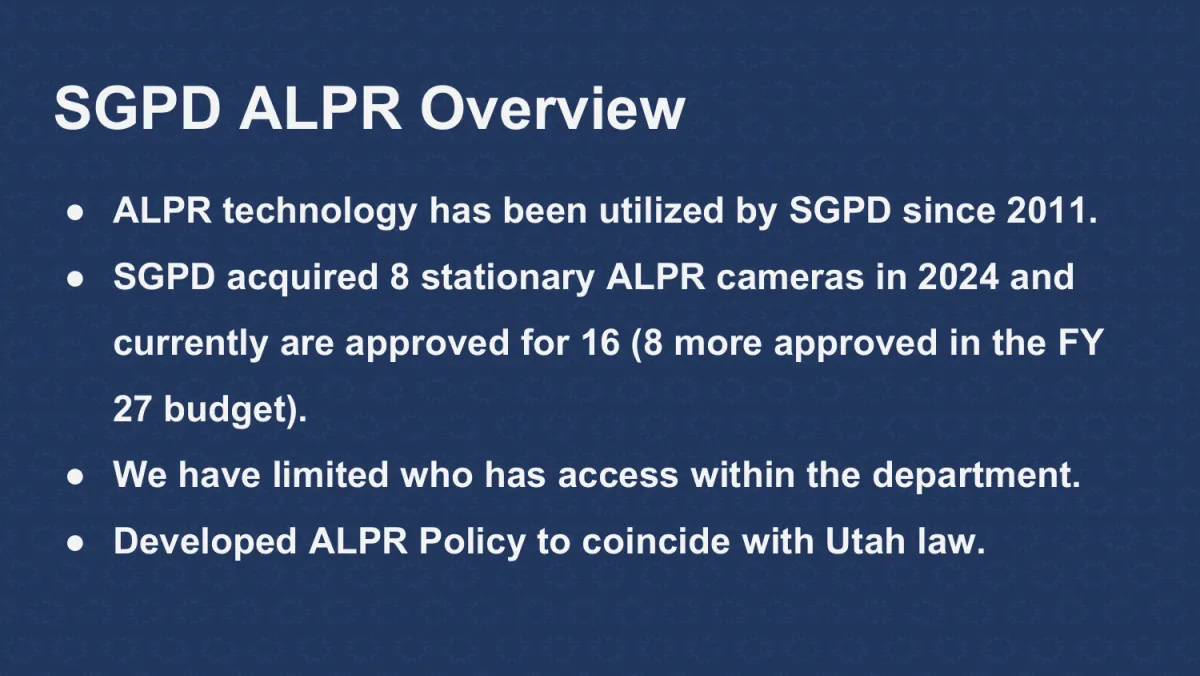
The St. George Police Department has eight stationary automated license plate reader (ALPR) cameras and is approved for 16. According to a department presentation in the City Council's agenda packet, SGPD bought the first eight stationary cameras in 2024, and eight more were approved in the FY 27 budget. The department says it has used ALPR technology since 2011.
The council will discuss license plate readers at its work meeting Thursday, October 22, 2026, at 4 p.m. in the City Council Conference Room at City Hall, 61 S. Main St., in St. George. It is the second item on the agenda, listed as "Discussion regarding license plate readers." No vote is scheduled.
| Question | What the packet says |
|---|---|
| Using ALPR since | 2011 |
| Stationary cameras now | 8, bought in 2024 |
| Approved total | 16 (8 more in the FY 27 budget) |
| Allowed uses | Active criminal investigations, outstanding warrants, missing or endangered people, stolen vehicles |
| Data kept | No longer than nine months unless tied to a warrant, preservation request or disclosure order |
| Search logs kept | At least five years |
What the Police Presentation Says
The SGPD presentation, titled "ALPR Technology," makes these points:
- Who has access: the department says it has limited who has access within SGPD and developed an ALPR policy to match Utah law.
- Audits: audits are run on agency users and on "shared access users," with customizable audit parameters and detailed results, for both periodic and "acute" auditing needs.
- Penalties for misuse: criminal penalties, a reporting obligation to Utah POST (Peace Officer Standards and Training), and POST disciplinary action.
- What ALPRs can and cannot do: the slide lists topics including still shots versus live video monitoring, "constant vs. motion", "object recognition vs. facial recognition," and describes the technology as a "puzzle piece, not a magic wand." The slide does not explain these points in writing. They are listed as talking points for the meeting.
Cases the Department Cites
The last slide lists three examples:
- Serial burglaries: ALPR data provided the only lead to identify suspects in a string of burglaries that targeted four St. George businesses during a multi-state crime spree.
- Stolen vehicle and fraud lab: a stolen vehicle alert led to recovery of the vehicle and a stolen gun, and to identification of a fraud lab holding information on hundreds of victims.
- Missing person: the system helped locate a missing endangered person with memory and medical issues who had been lost and driving for four hours.
The slides do not give dates, case numbers or arrest details for these examples.
The Department's ALPR Policy
The packet includes SGPD Policy 424, "Automated License Plate Readers (ALPRs)," from the department's Lexipol policy manual. It says ALPR data may be used only for official law enforcement business, citing Utah Code 41-6a-2003, and only for four purposes: an active criminal investigation, apprehending someone with an outstanding warrant, locating a missing or endangered person, or locating a stolen vehicle.
Other rules in the policy:
- No one may operate ALPR equipment or access the data without department-approved training.
- Officers should, if practicable, verify an ALPR hit through the appropriate law enforcement database before taking enforcement action based solely on an alert.
- Data not reasonably related to official law enforcement business is to be purged as soon as practicable, and no data is kept longer than nine months unless it is subject to a warrant, preservation request or disclosure order.
- Access must go through a login system that records who looked at what, and when. The number of searches, crime types and incident numbers are kept for at least five years.
- ALPR data from a non-governmental device may be obtained only with a warrant or court order.
- Data can be shared with other law enforcement or prosecutorial agencies only after a written request is reviewed and approved. The data is not open to public review.
Vendor Documents in the Packet
The packet also contains blank, unsigned vendor paperwork: a Motorola Solutions customer agreement, a Vigilant Solutions contract acknowledgment, and a template agreement for sharing plate detection data and "hotlists" between agencies on Vigilant's hosted system. Motorola fee sheets list an annual subscription of $2,000 per fixed LPR camera with cellular service. A separate hosted-service sheet lists $250 a year per camera license key after year five and an optional $1,200 annual cellular data plan per camera. The packet does not say which option the city would choose, how many cameras the forms would cover, or the total cost. It also does not say where the cameras are or where the new ones would go.
The same work meeting opens with a discussion of the Temple View concept for the old hospital site. For more on public safety spending this fall, see the city's new emergency services sales tax.
For the rest of the day's agenda, see our Oct. 22 council agenda roundup.
Frequently Asked Questions
Does St. George use license plate reader cameras?
Yes. The St. George Police Department says it has used ALPR technology since 2011 and bought eight stationary ALPR cameras in 2024.
Is St. George adding more license plate readers?
Yes. The department says it is approved for 16 stationary cameras, with eight more approved in the FY 27 budget.
How long does St. George Police keep license plate reader data?
Policy 424 says data is kept no longer than nine months unless it is subject to a warrant, preservation request or disclosure order. Data not related to official law enforcement business is to be purged as soon as practicable.
What can St. George Police use license plate reader data for?
Only for an active criminal investigation, to apprehend someone with an outstanding warrant, to locate a missing or endangered person, or to locate a stolen vehicle, according to Policy 424.
Do St. George license plate readers use facial recognition?
The presentation lists "object recognition vs. facial recognition" as a discussion topic but does not explain it in writing, and the packet does not say whether the cameras use facial recognition.
Will the City Council vote on license plate readers Oct. 22?
No. The item is listed as a discussion only.
Sources
- Utah Public Notice Website: St. George City Council work meeting agenda, Oct. 22, 2026
- City of St. George: Oct. 22, 2026 work meeting agenda packet, including the SGPD "ALPR Technology" presentation, vendor documents and Policy 424 (PDF)
Published October 18, 2026. We will update this page after the October 22 work meeting.